 Viral News Trending Stories & Breaking Internet News
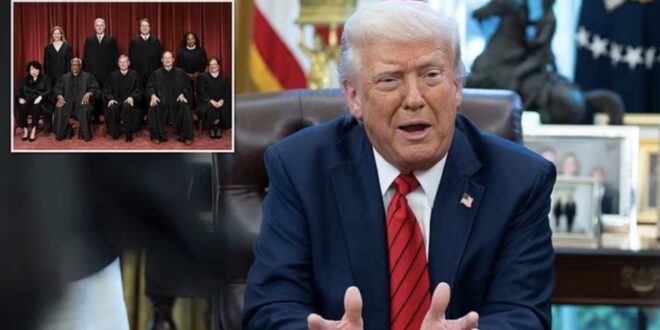
The U.S. Supreme Court appears poised to narrow how federal courts apply Section 2 of the Voting Rights Act, a shift that could significantly reduce legal challenges to Republican-led redistricting efforts and potentially strengthen the GOP’s chances of retaining control of the House in the 2026 midterm elections.
At the center of the debate is whether courts should continue treating race-based claims separately from partisan considerations when reviewing congressional maps. A ruling that limits Section 2 enforcement could insulate state lawmakers from lawsuits alleging racial vote dilution when voting patterns closely mirror party affiliation—a common feature of modern electoral politics, particularly in the South.
The potential impact is substantial. Voting rights organizations aligned with Democrats warn that weakening or eliminating Section 2 protections could allow Republican-controlled legislatures to redraw as many as 19 congressional districts to their advantage, reshaping the national political landscape.
Speaking on Fox & Friends, attorney Mehek Cooke said recent Supreme Court signals suggest the justices are offering what she described as a “road map” for President Donald Trump’s administration and Republican lawmakers seeking to defend partisan redistricting decisions in court.
Those signals emerged during re-arguments in Louisiana v. Callais, a closely watched case involving the state’s congressional map. A conservative majority on the Court appeared receptive to an approach supported by the Trump Justice Department that would raise the bar for plaintiffs alleging racial vote dilution in districts where race and party affiliation strongly overlap.
The case stems from Louisiana’s 2022 congressional map, which a federal district court found likely violated Section 2 by concentrating Black voters—who make up roughly one-third of the state’s population—into a single majority-Black district out of six. In response, state lawmakers adopted a revised map in 2024 creating a second majority-Black district.
That fix, however, prompted a lawsuit from white voters who argued the new map amounted to unconstitutional racial gerrymandering. A federal judge agreed, setting the stage for Supreme Court review.
After initially hearing arguments in March, the justices ordered additional briefing on the constitutionality of Section 2 itself. Over the summer, Louisiana reversed its position and urged the Court to curtail or eliminate race-conscious redistricting altogether. Meanwhile, Black voters who brought the original challenge defended the revised map as a necessary remedy for documented dilution of minority voting power.
While conservative justices showed little appetite for striking down Section 2 entirely—a provision enacted in 1965 and strengthened in 1982—they focused on a narrower legal theory advanced by Principal Deputy Solicitor General Hashim Mooppan.
Citing the Court’s 2019 decision in Rucho v. Common Cause, which barred federal courts from adjudicating partisan gerrymandering claims, Mooppan argued that states should be permitted to justify district maps based on legitimate partisan goals, even when those goals overlap with racial demographics. Under this framework, lawmakers could prioritize political advantage without violating Section 2, provided race is not the sole motivating factor.
Chief Justice John Roberts questioned how this approach would align with the Court’s prior rulings, including Allen v. Milligan in 2023, which required Alabama to create a second majority-Black district. Roberts appeared focused on reconciling any new standard with existing precedent, particularly the Thornburg v. Gingles test governing vote dilution claims.
Justice Brett Kavanaugh, a pivotal vote in Allen, raised the possibility of limiting Section 2 remedies to temporary measures, suggesting they may require an eventual expiration once their purpose has been fulfilled. Justice Samuel Alito pressed further, questioning whether courts are exceeding their authority when race and party affiliation are closely intertwined.
Outside the courtroom, voting rights groups are bracing for the consequences of a potential ruling that weakens Section 2. Fair Fight Action and the Black Voters Matter Fund recently produced an analysis shared with POLITICO warning that such a decision could all but guarantee continued Republican control of the House.
The report identified 27 congressional districts nationwide that could be redrawn in ways favorable to Republicans under the current legal environment, with 19 of those changes directly tied to the possible erosion of Section 2 protections. While the groups acknowledge that a ruling before the 2026 midterms is not certain, they say it remains a realistic possibility.
If the Court adopts a narrower interpretation of Section 2, the decision could mark one of the most consequential shifts in voting rights law in decades—reshaping congressional maps and altering the balance of power well beyond the next election cycle.

Equili